The Complete Morel Hunter's Guide: Everything You Need to Find More This Season
Quick answer: Morels fruit in spring when soil temperature at about 4 inches reaches roughly 45–60°F, usually March through May depending on latitude and elevation. Look near dying elms, ash, old apple trees, tulip poplars, and cottonwoods, and in burn sites. Confirm every morel by slicing it lengthwise: true morels are completely hollow. Always cook them, because raw morels can make you sick.
Every spring, millions of people head into the woods with one thing on their mind: morels. Morchella species — with their honeycomb caps and hollow, earthy interiors — are the most sought-after wild mushroom in North America. They're delicious, they're finite, and the window to find them is brutally short.
Most people come home empty-handed. A smaller group finds a few. And then there are the people who find them every single year, in the same spots, in impressive numbers. The difference between those groups isn't luck — it's knowledge, timing, and a system.
This guide is everything you need to close that gap.
What Are Morels?
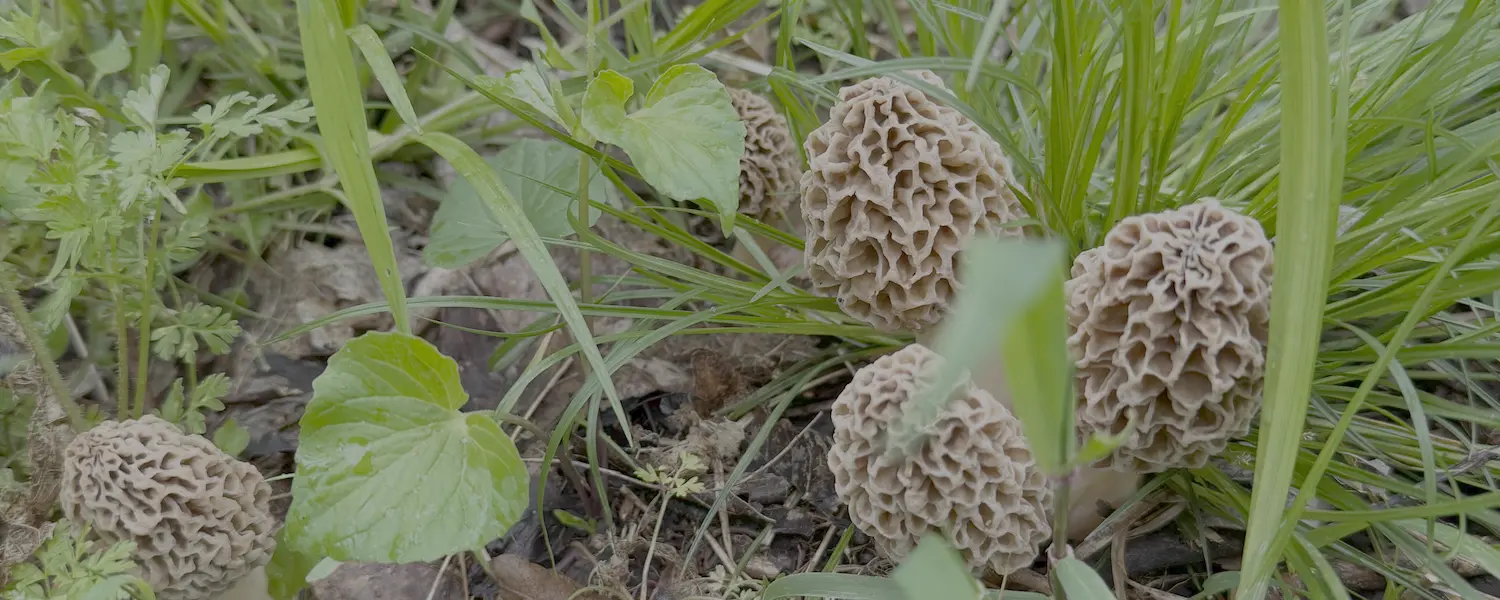
Morels belong to the genus Morchella and are true sac fungi (Ascomycetes), not gill mushrooms. The cap is covered in a pitted, honeycomb-like network of ridges and pits — completely unlike anything dangerous enough to confuse them with, once you know what you're looking at. They are always hollow from cap tip to the base of the stem when sliced vertically. That's your primary confirmation.
Species to Know
There are more Morchella species than most field guides acknowledge — DNA work has split what we used to call "the yellow morel" into many distinct species. A 2012 taxonomic revision recognized 19 species in North America alone, 14 of them new to science. For practical hunting purposes, you'll encounter three main groups:
- Yellow/True Morels (M. americana, M. esculenta complex) — the classic. Tan to golden-yellow, medium to large, typically the most abundant
- Black Morels (M. angusticeps, M. elata complex) — darker, more elongated, often appear first in the season and favor conifers and burns
- Half-Free Morels (M. punctipes) — the cap attaches partway down rather than at the base; a love-them-or-hate-them find, great in numbers
What About False Morels?
The main lookalike concern is Gyromitra species — "false morels" or "brain mushrooms." The key differences:
- Gyromitra caps are brain-like and lobed, not pitted in a honeycomb pattern
- Gyromitra are not hollow — the interior is chambered and cottony
- True morels are always attached at the base of the cap; Gyromitra are saddle-shaped and loosely draped
If it's hollow end-to-end and the cap has a regular pitted structure, you have a true morel. The Missouri Department of Conservation puts it simply: false morels have a chambered interior, true morels are completely hollow. False morels contain gyromitrin, toxin levels vary unpredictably from one mushroom to the next, and the MDC does not recommend eating any of them.
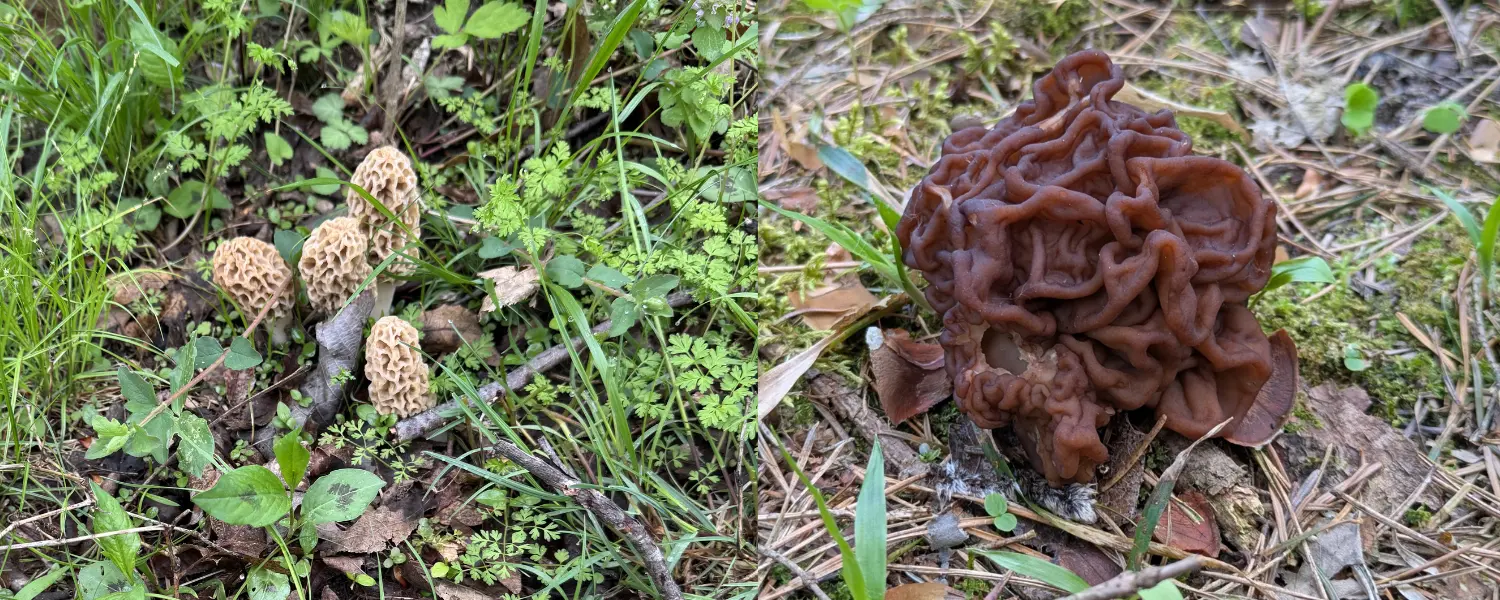
Left: true morel with a hollow, pitted cap. Right: Gyromitra (false morel) with a wrinkled, brain-like cap and chambered interior — never hollow end-to-end.
The Timing Window: Reading the Season
Timing is everything with morels. Miss it by a week and you find nothing but decomposing remnants. The season runs roughly March through May across most of North America, but the when in your specific area depends on a handful of environmental factors — none of which are fixed to a calendar date.
Soil Temperature Is the Real Calendar
Morels fruit when soil temperatures hit the right range at a depth of about 4 inches. Ohio State University Extension puts first emergence at around 45–50°F, and Iowa State University Extension cites 50–60°F. Air temperature is a rough proxy, but soil temp is the real signal (here's why). You can track this with a soil probe from a garden center, or through agricultural weather stations that publish readings online.
Research from the University of Missouri, summarized by Iowa State, goes a step further. It found that accumulated soil warming was the best predictor of the first morels: about 410 degree-days (°F) over the preceding 20 days. In other words, a sustained warm stretch matters more than any single day's reading.
The pattern usually goes:
- Below 45°F — too early, mycelium is dormant
- 45–55°F — black morels and early yellows begin to appear
- 55–65°F — peak season for yellow morels
- Above 70°F consistently — season ends, mushrooms appear and abort quickly
What you want to watch for is a stretch of warm days and cool nights with soil temps in that sweet spot — morels love that diurnal swing. A few days of rain followed by warming is the classic recipe. See the best weather conditions for morel hunting for the full sequence.
This is where having historical data on your spots pays enormous dividends. If you know that a particular hillside hit 52°F soil temp on April 8th last year and produced well, you know when to be back there this year. Tracking soil conditions at each of your finds — not just noting "it was warm" — turns a vague sense into actionable intelligence.
Elevation and Aspect Matter
Morels don't fruit at the same time everywhere. South-facing slopes warm up faster and produce earlier. North-facing slopes stay cool longer and can extend your season by a week or two after your southern spots are done.
Higher elevations warm later, so the season arrives later the higher you go. If you hunt at multiple elevations, you can follow the season uphill as spring climbs. Foragers who work this pattern systematically can stretch their season from three weeks to six.
Habitat: Where Morels Actually Live
Morels are mycorrhizal or saprotrophic depending on the species, and their tree associations are one of the most reliable clues for finding them. Learn the trees and you learn the mushrooms.
The Big Four Tree Associations
Elm (Ulmus spp.) — arguably the most productive morel habitat in the Midwest. Dying and recently dead elms are legendary among morel hunters. Dutch elm disease has been devastating the American elm for decades, which means there's no shortage of dead and dying trees in woodlands across the country. Look for elms with loose, flaking bark and no leaf buds, often along stream edges and bottomlands.
Ash (Fraxinus spp.) — with emerald ash borer now having reached most of the continent, ash trees are dying in massive numbers, creating new morel habitat every year. Same principle as elm: recently dead trees in the right ecosystem can be incredibly productive.
Apple and Old Orchard Trees — abandoned orchards are a morel hunter's secret weapon. Old, dying apple trees in overgrown orchards produce yellow morels reliably, often in numbers that seem disproportionate to the apparent habitat. These spots are often on private land — worth asking permission.
Tulip Poplar (Liriodendron tulipifera) — dominant in Appalachian and mid-Atlantic forests, this is the go-to tree for morel hunters in the eastern US. Look along slopes and coves in mixed hardwood forests.
Cottonwood and Sycamore — in the West and along major river systems, these riparian species are productive morel hosts. Look in sandy, moist soils along floodplains.
Secondary Habitat Indicators
Beyond specific tree species, train your eye to recognize the broader habitat signature:
- Riverbanks and creek bottoms — moisture-retaining soils, dying riparian trees, excellent drainage with periodic flooding
- Disturbed ground — forest roads, deer trails, any area where the soil has been disturbed in the past few years
- Burn sites — black morels are famous for erupting in massive numbers the spring following a forest fire. Burn hunters are a dedicated subculture
- South-facing slopes with loose, loamy soil — good drainage, early warming, mineral-rich substrates
When you find a productive spot, note everything about it. Not just the GPS pin, but the specific tree species present, the slope and aspect, the soil type, nearby water sources, and the canopy density. These details are what let you find analogous spots and predict where morels will appear in terrain you've never hunted.
How to Hunt: Finding the Mushrooms
Morel hunting is part pattern recognition, part meditation. Here's how to sharpen both.
Move Slowly and Look Through the Leaf Litter
Morels are masters of camouflage. Their brown-on-brown coloring against a forest floor of last year's leaves makes them almost invisible until your brain learns the shape. The first few seasons, you'll walk past dozens without seeing them.
The technique that helps most: scan slowly in irregular patterns, not straight lines. Grid the ground systematically but let your eyes rest on mid-distance rather than scanning frantically up close. Morels often reveal themselves when you're looking slightly past them.
Once you find one, stop. Don't immediately reach for it. Stand still and look around carefully from that exact position. Morels are rarely alone. There are almost always more within a few yards — and if you rush, you'll trample them before you see them.
Wind Direction and Light
Hunt with the sun at your back when possible — morels cast a tiny shadow in the pitted cap that catches light in a distinctive way. Experienced hunters sometimes walk a grid in one direction, then loop back in the opposite direction specifically because the light changes how the mushrooms appear.
The Dog Trick
It's anecdotal but widely reported: dogs with good noses can be trained to find morels by scent. More practically, your own nose becomes useful after a few seasons. Fresh morels have a subtle, earthy, pleasantly fungal scent that becomes recognizable.
Harvesting Right
Use a mesh bag or open basket — not a plastic bag. Morels need airflow, and a mesh bag allows spores to disperse as you walk, potentially seeding future flushes. This is good forager practice.
Cut or pull? Cut at the base with a clean knife, leaving the base intact. Some hunters argue pulling is fine since the mycelium network is underground; others prefer cutting to minimize disturbance. Either is defensible.
Don't over-harvest. Leave some behind — especially at a spot you want to produce for years. Taking everything you find works once. Taking most of what you find and leaving a few to spread spores works for a lifetime.
Logging Your Finds: The Discipline That Separates Repeat Producers
If you're new to this, start with how to track foraging spots on your phone.
Here's the thing that separates occasional morel hunters from people who fill their freezers every spring: systematic spot documentation.
A GPS pin is the beginning, not the end. The morel hunters who return to the same spots year after year and actually find mushrooms are tracking:
- The specific microhabitat (which elm tree? what size? how dead?)
- The soil conditions at time of find (moist? dry? recent rain?)
- The slope and aspect
- Nearby landmark trees and canopy structure
- Air and soil temperature at time of find
- The date relative to the season's progression, not just the calendar date
When you tag a find with all of this context, you're not just saving a location — you're saving a recipe for why that location produced. Next year, when you have similar conditions earlier in the season, you know exactly where to check.
The frustrating thing about morels is that a spot that produced 40 mushrooms last April might give you zero this April if you time it wrong. The same conditions that drove the flush last year have to be recreated. If you logged "52°F soil, 3 days post-rain, elm snag on north bank of creek" — you can look for that signature again and hit your spots at the right moment rather than wandering hopefully.
Year Two and Beyond: Return Trips
Your first-year spots are valuable. But they become dramatically more valuable by year two, and that value compounds as long as you maintain the documentation.
Here's why: morel mycelium is perennial. The same organism fruits in the same location for years, sometimes decades. Once you've confirmed a productive spot, that spot is potentially yours for life — assuming the habitat doesn't change (the tree doesn't fully decay, the site doesn't get logged, etc.).
The hunters with decades of experience aren't covering new ground every spring. They're returning to a curated list of spots they know, checking them in the right sequence based on elevation and aspect, and timing each visit to match the conditions that historically produced. It's less like hunting and more like farming.
Preserving the Harvest
Fresh morels will last 3–5 days in the refrigerator, loosely wrapped in a paper bag to allow airflow.
For longer storage:
Dry sautée and freeze — cook them in a dry pan until their moisture releases and evaporates, then freeze in portions. Retains flavor better than freezing raw.
Dehydrate — slice lengthwise and dehydrate at 95–105°F until completely brittle. Rehydrate in warm water for 20 minutes. Dried morels keep for years and are excellent in sauces and risottos.
Never eat raw. In 2023, 51 people got sick after eating at a Montana restaurant that served morels. A CDC investigation found that eating raw morels was more strongly linked to illness than eating cooked ones, and the more someone ate, the more likely they were to get sick. The exact toxin isn't known. Always cook morels thoroughly. For more on staying safe, read the foraging safety rules that actually matter.
This Season's Action Plan
- Track soil temperatures starting in late February for your region — not just air temps
- Scout your target tree species now, before leaves emerge and elms are easy to identify by bark and shape
- Permission first — some of the best morel habitat is on private farmland. Ask landowners now, before season
- Log every find with full context, not just a GPS pin
- Note what you almost found — spots where conditions looked right but mushrooms weren't up yet are valuable intelligence for the following year
The morel season is short, unforgiving, and completely worth the obsession. Go find some — and then make sure you remember where.
Happy hunting. And log your spots.
Sources
- Kuo, M. et al. (2012). Taxonomic revision of true morels (Morchella) in Canada and the United States. Mycologia 104(5): 1159–1177.
- Iowa State University Extension (2024). Soil Temperatures as Predictors for Mushroom Emergence.
- Ohio State University Extension, Fairfield County (2020). Morel mushroom information.
- Missouri Department of Conservation. Big Red False Morel and Morels field guides.
- CDC MMWR (2024). Outbreak Linked to Morel Mushroom Exposure — Montana, 2023.